The Role of Soup in Cambodian Family Meals

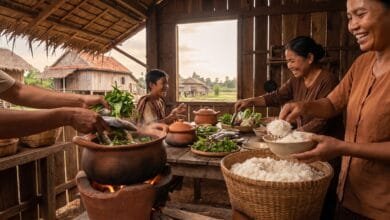
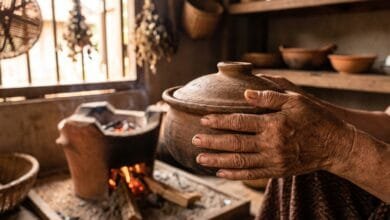
Steam rises from a clay pot on a simple stove. Inside: fish, green papaya, moringa leaves, and a broth soured with tamarind. This is samlor — and it is the heart of the Cambodian table. In Cambodian soup family meals, soup is not a starter or a side dish. It is the centerpiece, the daily constant, and often the reason the family gathers at all.
Understanding Cambodian food culture means understanding soup. Not just as a recipe, but as a daily practice — a way of cooking that is practical, deeply social, and passed down through generations without written instruction.
What Is Samlor? A Definition
In Khmer, samlor (សម្ល) simply means soup. But the word carries more weight than its English translation suggests. In a Cambodian home, samlor is the dish that anchors the meal. It is prepared fresh almost every day, varies with what is available, and is served alongside steamed jasmine rice.
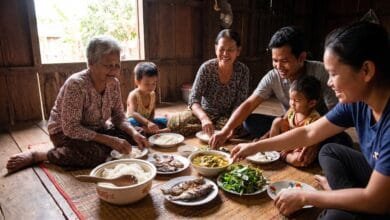
A typical Cambodian family meal includes rice, a soup, and one or two stir-fried or grilled dishes. The soup is not optional. In many households, a meal without soup would feel incomplete — as though something essential were missing.
Why Cambodian Soup Family Meals Matter
The importance of soup in Cambodian meals is not just about taste. It is about structure, nutrition, and social rhythm.
A traditional Cambodian meal is built around rice. Rice is the foundation — the thing that fills you up. But rice alone is dry, plain, and difficult to eat without accompaniment. Soup provides moisture, flavor, and nutrition. It softens the rice, carries the flavors of herbs and aromatics, and adds vegetables and protein to the meal.
In rural areas, where many families still cook with what they grow or catch, soup is also the most practical way to feed a household. A single pot can stretch a small amount of fish or meat across several people. Vegetables from the garden or market can be added freely. The result is a meal that is affordable, adaptable, and nourishing.
The Soups That Appear on Cambodian Tables
There is no single “Cambodian soup.” The category is broad, and different soups serve different moments.
Samlor Kako: The National Soup
Samlor kako (សម្លកកូរ) is often described as Cambodia’s national soup. Its name means “stirring soup,” a reference to the constant stirring required as ingredients are added. The dish began as a royal recipe that could include up to one hundred ingredients; today it is embraced by the whole population as a comfort meal that a grandmother might cook for a family lunch.
The base of samlor kako is green kroeung — a fragrant paste of lemongrass, turmeric, garlic, galangal, and kaffir lime — combined with prahok (fermented fish paste), roasted ground rice, and fish or meat. Vegetables such as green papaya, pumpkin, eggplant, long beans, and banana blossom are added according to what is available. Moringa leaves, known as mrum in Khmer, are considered essential. The roasted rice powder thickens the broth and adds a subtle nutty flavor.
Samlor kako is typically served at lunch with steamed rice. It is a complete meal in itself — protein, vegetables, and carbohydrates in one pot.
Samlor Machu Trey: The Everyday Sour Soup
While samlor kako carries a sense of occasion, samlor machu trey (សម្លម្ជូរត្រី) belongs firmly to the everyday table. This sour-and-savoury fish soup is made across Cambodia using whatever the day’s market has to offer.
The sourness comes from tamarind pulp, sometimes supplemented with pineapple for a sweeter edge. Freshwater fish such as snakehead or catfish are typically used, often cooked bone-in to enrich the broth. Prahok may be stirred in for depth, though it remains optional. The term samlor machu does not describe a single fixed recipe but an entire family of sour soups that vary by region, family, and season.
Samlor machu trey appears at Cambodian Sunday lunches, made with lemongrass, galangal, tomatoes, and whatever herbs are at hand. Served with jasmine rice, it is one of the dishes that best evokes Cambodian home cooking.
Samlor Prahal: The Fragrant Village Soup
Samlor prahal (សម្លប្រហើរ), meaning “fragrant soup,” is a staple food of Cambodian villages. Its base is made with chicken or fish stock and lemongrass, with vegetables added according to region. In mountain and coastal regions, the soup is made with kroeung; in river regions, a clearer version with less lemongrass is more common. A vegetarian version is referred to as mhob bouh — “as the monks eat”.
Kuy Teav: The Breakfast Soup
Not all Cambodian soups are eaten with rice. Kuy teav (គុយទាវ) is a rice noodle soup with pork stock, eaten primarily at breakfast. The word derives from Teochew Chinese, reflecting the influence of Chinese immigrants on Cambodian food culture. It is found at marketplace stalls, roadside vendors, and restaurants across the country, distinguished by its clear broth and array of herbs and garnishes.
Borbor: The Comfort Porridge
Borbor (បបរ) is rice porridge — a thinner, softer version of rice cooked with extra water. It is often the first solid food given to babies and the comfort food offered to someone who is unwell. During the Khmer Rouge period, many Cambodians subsisted almost entirely on a thin, watery borbor served from communal kitchens. Today it remains a simple, adaptable dish — sometimes plain, sometimes enriched with pork, chicken, or fish.
How the Soup Tradition Works
The daily practice of making soup in a Cambodian home follows a rhythm that is both practical and cultural.
In many households, the person responsible for cooking — often a mother, grandmother, or eldest daughter — decides the day’s soup based on what is available. This might mean ingredients from the morning market, vegetables from the family garden, or fish caught nearby. The soup is not planned far in advance; it responds to the day.
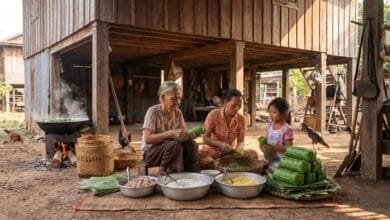
The cooking itself is often learned by watching rather than by reading. Recipes are passed down orally, from one generation to the next. A young girl might stand beside her grandmother, learning to pound kroeung, to taste the broth, to know when the fish is cooked. This knowledge is practical and embodied — it lives in the hands and the senses, not in a written recipe.
Food, Family, and the Shared Table
The social dimension of Cambodian soup is as important as its flavor.
At mealtime, the family gathers around a table or a mat. A large bowl of rice is placed in the center, surrounded by dishes — including the soup. Each person has their own bowl. They take rice from the common bowl, then ladle soup over it. The soup moistens the rice and carries its flavors.
This system is communal but individual. Everyone eats from the same dishes, yet each person controls their own portion. It is a practical arrangement that reflects a broader cultural value: sharing resources while respecting individual needs.
Soup also plays a role in hospitality. When guests arrive, offering food — including soup — is a way of welcoming them. A bowl of hot soup is a simple, sincere gesture of care.
Soup and Cambodian Traditions
Beyond daily meals, soup appears at festivals, ceremonies, and religious occasions.
At Pchum Ben, the festival of the ancestors, families prepare food to offer to monks at the pagoda. These offerings often include soups and curries, arranged in silver vessels before the monks. The food is believed to generate merit that benefits deceased relatives.
At Cambodian weddings, specific soups may be served. Ngam ngov, a pickled lime soup, is a traditional wedding dish, typically prepared with duck but now more commonly made with chicken or pork.
For Cambodian-Chinese households, chap chhay — a mixed vegetable soup — is prepared for Lunar New Year and the Ghost Festival. The soup represents luck, prosperity, and the continuation of traditions passed down through generations. Because it can be kept for several days, it becomes a meal that brings relatives and friends together even after the ceremonies end.
Regional and Family Differences
Cambodian soup culture is not uniform. It varies by region, family, and season.
Sour soups differ across the country. In Kampot, a clear fish broth soup called samlor prahal is a local specialty, made without prahok and cooked with chives and vegetables. In Siem Reap, samlor machu may include bamboo shoot and tiny freshwater shrimp. Khmer Krom communities in southern Vietnam have their own versions, featuring tomato, pineapple, catfish, lotus root, and holy basil.
Even within a single province, families make soups differently. One household might add pineapple to samlor machu trey; another might keep it strictly sour. One grandmother might insist on moringa leaves in samlor kako; another might use whatever greens are available.
This variation is not a weakness. It is the strength of a living tradition — one that adapts to its environment rather than following a fixed script.
How History Shaped the Tradition
Cambodian soup culture has been shaped by centuries of history, trade, and cultural exchange.
Some soups claim ancient origins. Modern Cambodian dishes are said to descend from those eaten during the Angkorian period, the great Khmer Empire of the 9th to 15th centuries. Samlor kako, in particular, is associated with royal kitchens and the abundance of the Angkorian court.
Chinese influence is visible in kuy teav, a rice noodle soup brought by Teochew immigrants who settled in Cambodia and the surrounding region. The dish became so thoroughly Cambodian that many today do not think of it as foreign.
French colonial rule introduced new ingredients and techniques, though soup remained a Khmer staple. More recently, the Khmer Rouge period (1975–1979) disrupted traditional food culture. Many recipes were lost; many cooks did not survive. The post-war decades have seen a gradual revival, with chefs and home cooks working to recover and preserve traditional dishes.
How Cambodian Soup Culture Is Changing
Cambodian food culture is changing, and soup is changing with it.
In cities like Phnom Penh and Siem Reap, busy schedules and long commutes mean fewer families eat lunch together at home. Soup might be bought from a vendor rather than made from scratch. Food delivery apps have made restaurant food more accessible. Younger Cambodians may know how to order samlor kako but not how to cook it.
At the same time, there is a visible revival of interest in traditional cooking. Chefs are researching forgotten recipes. Social media accounts share videos of grandmothers making soup. Cooking classes in Siem Reap and Battambang teach visitors — and sometimes locals — how to pound kroeung and balance a sour broth.
The change is not simply loss. It is adaptation. The soup pot has not disappeared from Cambodian life; it has moved into new contexts, carried forward by people who value what it represents.
Why This Tradition Still Matters
In a rapidly changing country, soup remains a daily connection to something older and steadier.
For many Cambodian families, making soup is not a chore. It is a rhythm — a way of marking the day, of caring for the people you love, of keeping alive knowledge that was never written down. The pot on the stove is a small, ordinary thing. But it carries the weight of generations.
For international readers, Cambodian soup family meals offer a window into a culture where food is not just sustenance but relationship. To understand soup is to understand something essential about Cambodia: the value of sharing, the wisdom of simplicity, and the quiet power of a daily ritual.
If you want to cook a Cambodian soup at home, see our recipes for [Samlor Kako] and [Samlor Machu Trey]. You might also enjoy our guide to [Cambodian ingredients] and our article on [Cambodian food culture].
Frequently Asked Questions
What is Cambodian soup called?
In Khmer, soup is called samlor (សម្ល). Specific soups have their own names, such as samlor kako, samlor machu trey, and samlor prahal.
Why do Cambodians eat soup every day?
Soup provides moisture and flavor for rice, adds vegetables and protein to the meal, and is a practical way to feed a family with available ingredients. It is also a daily ritual of family togetherness.
What is Cambodia’s national soup?
Samlor kako is often described as Cambodia’s national soup. It is a vegetable and fish soup thickened with roasted rice powder and flavored with kroeung and prahok.
Do Cambodians eat soup for breakfast?
Yes. Kuy teav, a rice noodle soup with pork stock, is a popular breakfast dish across Cambodia. Borbor, rice porridge, is also commonly eaten in the morning.
How is Cambodian soup different from Thai or Vietnamese soup?
Cambodian soups tend to emphasize sourness (from tamarind or pickled lime) and the use of prahok, a fermented fish paste. They are often simpler and less sweet than Thai soups, and less aromatic with herbs than Vietnamese pho.
What vegetables go into Cambodian soup?
Common vegetables include green papaya, pumpkin, eggplant, long beans, banana blossom, water spinach, and moringa leaves. The specific vegetables vary by region, season, and family preference.
Conclusion
Soup is not simply something Cambodians eat. It is the daily rhythm that brings families to the table, the practical wisdom that turns a few ingredients into a complete meal, and the quiet thread that connects generations. From the royal origins of samlor kako to the everyday sour fish soup simmered in a village kitchen, Cambodian soup family meals carry meaning far beyond nutrition.
The shared pot at the center of the table is a small, ordinary thing. But it represents care, resourcefulness, and the continuity of Khmer culture. As Cambodia changes, the soup pot remains — adapted, perhaps, but not abandoned. It is still there, steam rising, waiting for the family to gather.
To understand Cambodia, you do not need to look far. Sit at a family table, take a bowl of rice, and ladle soup over it. In that simple act, you will find the heart of Khmer life.
2 Comments