What People Ate in the Angkor Period: Food Culture of the Khmer Empire
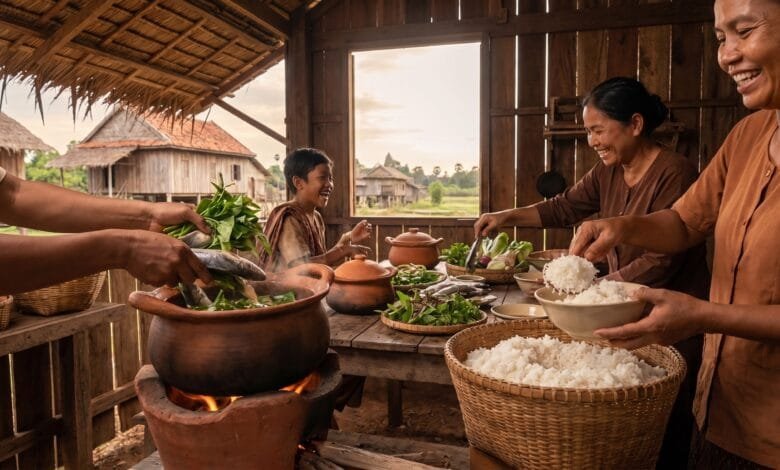
Imagine waking up in the shadow of Angkor Wat. The sun is just rising over the temple spires. Your day does not begin with prayer or work. It begins with rice.
For the people of the Angkor Empire, food was the center of daily life. The Khmer Empire, which dominated mainland Southeast Asia from the 9th to the 15th centuries, was not just a civilization of temples and kings. It was a civilization of farmers, fishers, cooks, and families. And at the heart of it all was food.
Angkor period food tells us a story about how millions of people lived, worked, and sustained one of the greatest empires in Southeast Asian history.
What Was the Angkor Period Diet?
The diet of the Angkor period was built on two foundations: rice and fish. These were not just foods. They were the pillars of Khmer civilization.
Archaeobotanical research from Angkor Thom, the capital city, provides clear evidence of what people ate. Samples from the 14th and 15th centuries show that Angkor’s inhabitants cultivated and consumed rice as their staple food, along with a variety of pulses. As one study puts it, Angkor’s inhabitants “continued their everyday lives cultivating and consuming their staple food, rice, with a suite of pulses”.
But the Khmer did not live by rice alone. Research from Angkor Wat and Ta Prohm reveals that people grew and ate a wide range of plants within temple enclosures. These plants were used for food, medicine, and ritual.
The Rice That Built an Empire
Rice was more than food. It was the foundation of the Angkorian economy and society.
Inscriptions from the Angkorian period describe the enormous quantities of rice required to sustain the empire. At Preah Khan temple alone, the daily consumption of rice amounted to ninety-seven kharís. Rice was required as offerings to the gods and to feed temple staff.
The Angkorian irrigation system was one of the most sophisticated in the ancient world. Large reservoirs called barays stored water during the rainy season. This allowed farmers to cultivate a second rice crop during the dry season, doubling agricultural production. The system was so effective that the rice fields of Angkor remained fertile for centuries.
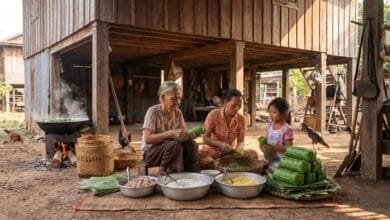
Rice was processed in homes and temples alike. Archaeobotanical samples show evidence of rice processing throughout the city. The grain was pounded, winnowed, and cooked in earthenware pots.
Fish from the Great Lake
If rice was the body of the Angkorian diet, fish was the soul.
The Tonle Sap — Southeast Asia’s largest freshwater lake — provided an abundant source of protein for the Khmer people. Fishing gave the population their main source of protein. Fish were consumed fresh or processed into preserved forms that could last for months.
The most important of these preserved fish products was prahok — fermented fish paste. Prahok has been made for over a thousand years. Its first mention comes from the Angkorian period. In a tropical climate where keeping food cold was impossible, fermenting fish was an essential way to preserve protein.
Zhou Daguan, a Chinese diplomat who visited Angkor in 1296, observed that the many varieties of fish were consumed as-is or processed for fish sauce or prahok. He also noted that shellfish were commonly eaten — clams, mud clams, and pond snails.
The walls of Angkor Wat and the Bayon temple depict fishing scenes. These bas-reliefs show people casting nets and catching fish — proof that fishing was not just a necessity but an integral part of Khmer life.
Fruits and Vegetables of the Angkorian Table
The Angkorian diet was not limited to rice and fish. People ate a remarkable variety of fruits and vegetables.
Zhou Daguan left us a detailed list of what the Angkorians grew and ate. For vegetables, he listed onions, mustard greens, chives, eggplants, watermelons, winter gourds, snake gourds, and amaranth. The vegetables that were not available were also noted: radishes, lettuce, chicory, and spinach.
For fruits, Zhou recorded lotus flowers, bananas, gourds, and watermelons. Other sources mention sugar palm trees, coconut palms, and various tropical fruits.
Archaeobotanical evidence confirms this picture. Researchers have identified bananas, palm trees, and spice plants like long pepper and crepe ginger growing within the temple enclosures of Angkor Wat and Ta Prohm. Long pepper (Piper retrofractum) was already being cultivated in Cambodia by the 13th century.
Household gardens were an important part of Angkorian life. These gardens provided families with fresh vegetables, fruits, and herbs. The practice of growing food at home continues in Cambodian villages today.
Meat and Animal Products
What about meat? The Angkorians ate meat, but not as much as they ate fish.
Zhou Daguan mentioned chickens, ducks, cows, horses, pigs, and goats as domesticated livestock. However, he specifically noted that cows, crabs, and frogs were not eaten. This is a fascinating detail that shows how food taboos and preferences have changed over time.
Inscriptions from the Angkorian period also mention dairy products. References to milk, curd, and clarified butter appear abundantly in ancient Khmer epigraphy. Dairy played an important role as sacred food and in royal consecrations and funerary rites. However, dairy consumption did not carry over into the modern Cambodian diet.
How Angkorians Cooked Their Food
The kitchens of the Angkor period were simple but effective.
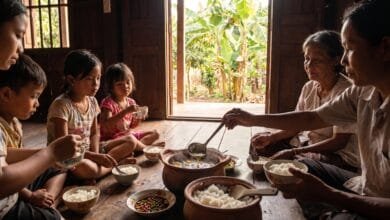
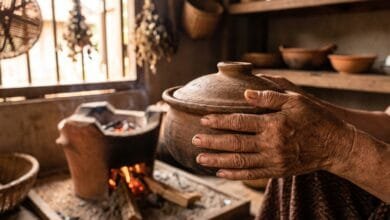
Poor families cooked food using earthenware pots placed over three stones in the ground. They ate from organic containers — leaf bowls — and used coconut husk spoons. Wealthier families might use metal objects.
Archaeological evidence reveals that clay stoves were used during the Angkor period. These stoves are similar to the clay stoves used by Cambodian people today. Numerous earthenware stove fragments have been identified in the archaeological record.
A small circular group of stones and brick — likely a hearth — was identified at Angkor Wat. On top of this feature was a group of broken ceramics and burnt plant remains. Excavations at Ta Prohm uncovered a trash pit that contained broken pottery — evidence of daily cooking and eating.
Zhou Daguan observed that the Angkorians did not know how to make soy sauce or vinegar. Instead, they used tamarind to add sourness to their sauces. This observation is still relevant today — tamarind remains an essential ingredient in Cambodian cuisine.
What Angkorians Drank
The Angkorians enjoyed a variety of beverages.
Zhou Daguan identified five varieties of alcohol: honey wine, rice wine, sugar wine, palm wine, and a drink made from the pengyasi leaf.
Rice wine, known as sra peang or “jar wine,” has been consumed by Khmer people since Angkorian times. Archaeological traces of wine jars from the Angkor era have been found. The strength of this beverage is typically 15 to 25 percent alcohol by volume. Bas-reliefs at Angkor Wat depict people drinking from wine jars.
Palm wine, made from the sugar palm tree, was also common. The sugar palm provided not just wine but also palm sugar — a sweetener still used in Cambodian cooking today.
Food and Religion in the Angkor Period
Food was deeply connected to religion in the Angkor period.
Temples were not just places of worship. They were economic and social centers that distributed food to thousands of people. The plants within temple enclosures were grown for ritual and medicinal use as well as for food.
Buddhist monks in the Angkor period ate just one meal a day, collected from the homes of almsgivers. They had no qualms about consuming fish or other animal flesh, though they did not drink alcohol. Monks also made offerings of food to the Buddha, including burning new rice.
On the occasion of a death, Zhou observed that fried rice was tossed along the route of the funeral procession. For Khmer people in the 13th century, food was essential for satisfying spiritual devotion.
In contrast, Hindus — called baïswei by Zhou — were fewer in number. They neither accepted foods from laypeople nor made offerings to idols.
How We Know About Angkor Period Food
Our knowledge of Angkor period food comes from three main sources.
Archaeobotany: Scientists have analyzed plant remains from Angkor Thom, Angkor Wat, and Ta Prohm. These remains include both charred and desiccated seeds, rice husks, and other plant materials. They provide direct evidence of what people ate.
Inscriptions: Khmer inscriptions from the Angkorian period describe food production, offerings, and temple economies. These texts mention rice, pulses, fruits, and other foods.
Zhou Daguan’s Account: The Chinese diplomat Zhou Daguan visited Angkor in 1296 and spent nearly a year there. His book, The Customs of Cambodia, is the only detailed written account of daily life in the Angkor period. It provides invaluable information about food, cooking, and eating habits.
From Angkor to Today
Many of the food traditions of the Angkor period survive in modern Cambodia.
Rice remains the staple food. Fish — both fresh and fermented — is still central to the diet. Prahok continues to be made using methods that have changed little in a thousand years. Tamarind is still used to sour sauces. Palm sugar is still produced from sugar palm trees.
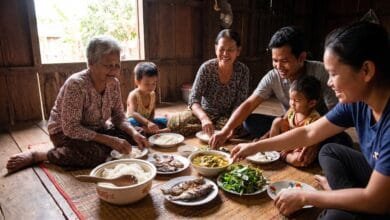
The continuity is remarkable. When you eat a meal in Cambodia today — rice, fish, prahok, and vegetables — you are eating something very similar to what people ate in the Angkor period.
Why This Food Tradition Still Matters
Understanding Angkor period food matters for several reasons.
First, it connects us to the daily lives of millions of people who built one of the greatest civilizations in history. The temples of Angkor are stone monuments to kings and gods. But the food traditions of Angkor are monuments to the people.
Second, it shows us that food is not just about survival. It is about culture, community, and identity. The Angkorians did not just eat to live. They ate to connect — with each other, with their gods, and with their land.
Third, it reminds us that Cambodian food culture is ancient and enduring. When you taste prahok or eat a bowl of rice, you are tasting history.
Frequently Asked Questions
What did people eat in the Angkor period?
People in the Angkor period ate a diet based on rice and fish, supplemented with vegetables, fruits, pulses, and occasionally meat. They also consumed fermented fish paste (prahok) and a variety of beverages including rice wine and palm wine.
Was rice the most important food in the Angkor Empire?
Yes, rice was the staple food and the foundation of the Angkorian economy. The empire’s sophisticated irrigation system allowed for multiple rice harvests each year.
Did Angkorians eat meat?
Yes, but fish was the primary source of protein. Chickens, ducks, pigs, and goats were raised for meat, but cows were not eaten. Frogs and crabs were also not consumed.
What fruits and vegetables did Angkorians eat?
Angkorians ate bananas, watermelons, gourds, onions, eggplants, mustard greens, chives, amaranth, and various tropical fruits. They also grew spices like long pepper.
How do we know what Angkorians ate?
Our knowledge comes from three sources: archaeobotanical remains (seeds, rice husks, and other plant materials found in excavations), Khmer inscriptions, and the detailed account of Chinese diplomat Zhou Daguan who visited Angkor in 1296.
Is Angkor period food still eaten in Cambodia today?
Yes. Rice, fish, prahok, and many of the vegetables and fruits eaten in the Angkor period remain central to Cambodian cuisine today.
Conclusion
Angkor period food tells a story that the temples alone cannot tell. It is the story of millions of people who lived, worked, and ate in the shadow of Angkor Wat. It is the story of rice fields and fishing nets, of clay stoves and earthenware pots, of family meals and temple offerings.
When we understand what people ate in the Angkor period, we understand something essential about Cambodia itself — a culture built on rice and fish, on community and tradition, on food that connects people to each other and to their land.
The food of the Angkor period is not just history. It is alive today in every Cambodian kitchen, in every bowl of rice, in every jar of prahok. It is a reminder that the greatest civilizations are built not just on stone and gold, but on the simple act of sharing a meal.