Kroeung: The Essential Cambodian Spice Paste Every Traveler Should Know
If you have eaten Cambodian food, you have almost certainly tasted kroeung — even if you did not know its name. Kroeung is the fragrant herb and spice paste that forms the flavor foundation of countless Khmer dishes, from the national dish amok to everyday stir-fries and soups. It is not a single recipe but a family of pastes, each built from fresh aromatics like lemongrass, galangal, turmeric, and kaffir lime leaves. For travelers, understanding kroeung is one of the fastest ways to make sense of Cambodian cooking. Once you recognize its aroma, you will start noticing it everywhere. This article explains what kroeung is, what it tastes like, how Cambodian cooks use it, and how you can encounter it during your travels.
What Is Kroeung?
Kroeung (Khmer: គ្រឿង, romanized as krœăng, pronounced roughly “krung”) is a generic Khmer word for a family of spice and herb pastes. The term does not refer to one fixed recipe. Instead, it describes a category of preparations, and many Cambodian dishes are named with the “-kroeung” suffix to indicate that a specific paste is central to the dish.
The word itself essentially means “ingredients” or “spices” in Khmer, which hints at its role: kroeung is the aromatic base that gives a dish its identity. A Cambodian cook might make kroeung for a curry, a stir-fry, a soup, or a stuffing, adjusting the herbs and proportions each time.
The Main Types of Kroeung
Kroeung falls into two broad categories that Cambodian cooks recognize as distinct.
Royal kroeung is the standardized, all-purpose paste used across many dishes. It is the closest thing to a “base recipe” in Khmer cooking. Individual kroeung is made for a specific dish, often with extra ingredients that suit that particular preparation. For example, a kroeung for a sour soup might include roasted rice for a smoky note.
Beyond these two categories, kroeung is also commonly identified by color:
- Yellow kroeung gets its color from fresh turmeric. This is the most common type and the base for dishes like amok and Khmer curry.
- Red kroeung uses dried red chilies, giving it a deeper color and more heat.
- Green kroeung relies heavily on fresh lemongrass and sometimes cilantro, producing a brighter, more herbaceous paste.
What Does Kroeung Taste and Smell Like?
The aroma of kroeung is immediately recognizable once you know it: lemongrass dominates, sharp and citrusy, layered with the piney warmth of galangal and the earthy, slightly bitter depth of fresh turmeric. Kaffir lime leaves add a floral, almost perfumed note. Garlic and shallots bring sweetness and savory depth.
The taste is complex rather than simply “spicy.” Yellow kroeung, the most common type, is aromatic and gently warming rather than hot, because its heat comes primarily from aromatics rather than chilies. Some versions include dried red chilies, which add a moderate kick, but the overall impression is fragrant and herbal rather than fiery. The paste itself has a thick, slightly fibrous texture when made traditionally with a mortar and pestle. When cooked in oil, the flavors bloom and intensify, filling a kitchen with a scent that is unmistakably Cambodian.
What Does Kroeung Look Like?
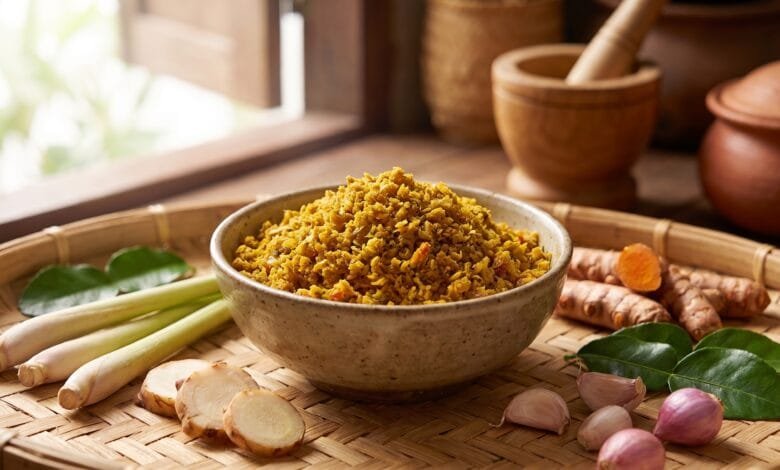
Fresh kroeung is a moist, textured paste. Yellow kroeung has a bright golden-yellow color from fresh turmeric. Red kroeung is deeper, ranging from brick red to dark orange. Green kroeung is lighter, with a pale green tint from lemongrass and herbs.
You will see it in several forms in Cambodia: freshly pounded at market stalls, sold in small plastic bags or containers, or packed into jars for home use. In restaurants, it appears as the aromatic base of a dish rather than as a condiment on the table. Travelers visiting a Cambodian market may see vendors pounding kroeung by hand with a heavy wooden mortar and pestle — a labor-intensive process that releases the essential oils from the herbs.
How Is Kroeung Used in Cambodian Cooking?
Kroeung is almost always cooked, not eaten raw. The typical method is to fry the paste in hot oil until it becomes fragrant, which is the signal that the aromatics have released their flavor. This step is called “frying the kroeung,” and it is the foundation of many Cambodian dishes.
Once the kroeung is fragrant, the cook adds the main ingredient — fish, chicken, pork, or vegetables — along with coconut milk, water, or broth depending on the dish. Kroeung is used in curries, soups, stir-fries, and stuffings. It can also be used as a marinade for grilled meats. In some preparations, it is combined with prahok (fermented fish paste) for a deeper umami layer.
Because kroeung is a base rather than a finished sauce, its flavor is meant to be absorbed by the other ingredients. It is not typically tasted on its own.
Which Cambodian Dishes Use Kroeung?
Kroeung appears in many of Cambodia’s most well-known dishes. Here are the most important ones:
- Amok trey — Cambodia’s national dish, a steamed coconut fish curry. Yellow kroeung provides the aromatic foundation, and the dish is traditionally steamed in banana leaves.
- Samlor kari — a chicken curry with coconut milk, built on kroeung along with shrimp paste.
- Samlor kako — a vegetable-heavy soup that uses kroeung as its base, often with roasted rice added for smokiness.
- Cha kroeung — a family of stir-fries, often made with beef, chicken, or pork, where the kroeung is fried with the meat and vegetables.
- Num banh chok — Cambodia’s famous breakfast noodle dish, served with a fish-based broth flavored with kroeung.
- Tuk kroeung — a dipping sauce made from pounded fish, kroeung aromatics, and prahok, served with fresh vegetables.
Where Does Kroeung Come From?
Kroeung is not a geographically specific product in the way that Kampot pepper or Kampong Speu palm sugar are. It is a preparation technique and flavor concept that exists throughout Cambodia. The herbs that go into it — lemongrass, galangal, turmeric, kaffir lime — grow across much of Southeast Asia.
What makes kroeung distinctly Cambodian is its particular combination and balance of ingredients, and its central role in Khmer cooking. The paste has been used in Cambodian stews and curries for centuries. Unlike Thai curry pastes, Cambodian kroeung traditionally emphasizes fresh turmeric and often avoids the heavy chili heat that characterizes neighboring cuisines.
How Is Kroeung Made?
Traditional kroeung is made by hand. The ingredients are finely chopped and then ground together using a heavy mortar and pestle. This is not a quick process. Pounding releases essential oils that a food processor cannot fully replicate, and many Cambodian cooks insist that the texture and aroma are noticeably different when the paste is made by hand.
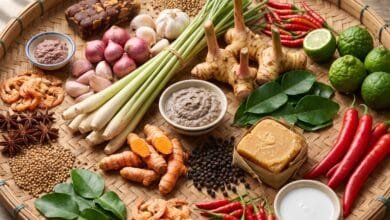
The core ingredients of a basic yellow kroeung are lemongrass (the tender inner part), galangal, fresh turmeric, kaffir lime leaves, garlic, and shallots. Some versions also include fingerroot, lesser galangal, or other rhizomes. Prahok is sometimes added, especially for dishes where a deeper umami is desired.
Once made, kroeung can be stored in the refrigerator for about a month or frozen for longer. Many Cambodian families prepare kroeung in batches and freeze it in small portions for convenience, a practice that has carried over to Cambodian communities abroad.
Why Is Kroeung Important in Cambodian Food?
Kroeung is arguably the single most important preparation in Khmer cooking. It is what distinguishes Cambodian dishes from those of neighboring countries, even when similar ingredients are used. The specific balance of lemongrass, galangal, turmeric, and kaffir lime — with turmeric playing a more prominent role than in Thai cooking — gives Cambodian food its characteristic fragrance.
For Cambodian families, making kroeung is often a communal activity. The pounding, chopping, and mixing are part of the rhythm of preparing a family meal. The paste connects everyday cooking to a longer culinary tradition that predates modern Cambodia.
Regional Differences
Kroeung varies by household and by region, but these differences are more about personal and family preference than strict regional styles. A cook in Battambang might make a kroeung with more turmeric, while someone in Kampot might emphasize lemongrass. Some families add ingredients like fingerroot or lesser galangal; others keep it simple.
What is consistent across Cambodia is the principle: fresh aromatics, pounded together, used as the base for cooking. The exact recipe is less important than the technique and the freshness of the ingredients.
Can Foreign Travelers Try or Buy Kroeung?
Kroeung is not something you buy off a shelf and eat directly. You experience it through dishes that use it as a base. When you eat amok, samlor kari, or cha kroeung in Cambodia, you are tasting kroeung.
That said, travelers can buy kroeung paste in Cambodian markets, where vendors often sell freshly pounded paste in small bags or containers. Some markets in Phnom Penh and Siem Reap have stalls where you can watch the paste being made. If you want to cook with kroeung at home, buying a container of fresh paste from a market is the most authentic option. It freezes well, so you can bring some back if you have freezer space.
In restaurants, you will not see kroeung listed on menus as a standalone item. It is an ingredient, not a dish. The way to try it is to order the dishes that rely on it.
How to Recognize Good Kroeung
Fresh kroeung should look moist and vibrant. Yellow kroeung should be a bright golden color, not dull or brown. The aroma should be sharp and herbal, with clear notes of lemongrass and citrus. If the paste smells flat or musty, it is likely old.
When buying from a market, look for vendors who are actively pounding or who keep their paste in clean containers. Freshness matters more than any other factor. If you are buying packaged kroeung outside Cambodia, check the ingredient list for artificial colors or excessive preservatives.
Can You Find Kroeung Outside Cambodia?
Kroeung paste is available in some Asian grocery stores in the United States, Australia, France, and other countries with Cambodian communities. It is often sold frozen or refrigerated, sometimes under brand names like Angkor. Availability varies significantly by location; cities with larger Cambodian populations are more likely to have it.
If you cannot find prepared kroeung, you can make a close approximation at home. The ingredients are increasingly available in mainstream supermarkets: lemongrass, galangal, fresh turmeric, kaffir lime leaves, garlic, and shallots. A food processor can stand in for a mortar and pestle, though the texture will be slightly different.
What Can You Use Instead?
There is no perfect substitute for kroeung because it is a specific combination of aromatics rather than a single ingredient. Thai yellow curry paste is the closest widely available alternative, but it is noticeably different — Thai pastes tend to include more chili and different proportions of aromatics. The resulting dish will still be flavorful but will taste more Thai than Cambodian.
If you are making a Cambodian dish and cannot find or make kroeung, a Thai yellow curry paste will work in a pinch. Just be aware that the flavor profile will shift. For dishes where kroeung is central, such as amok, the substitution is more noticeable.
What Should Travelers Know?
Kroeung is not spicy in the way that Thai or Indian curries can be. Yellow kroeung, the most common type, is aromatic and warming rather than hot. If you are sensitive to strong herbal flavors, start with a dish like amok, where the kroeung is tempered by coconut milk and steamed gently.
If you have a shellfish allergy, be aware that some kroeung preparations include prahok (fermented fish paste) or shrimp paste. Not all versions contain these ingredients, but it is worth asking.
For travelers who want to cook with kroeung after returning home, buying a container of fresh paste from a Cambodian market is the best option. It freezes well and will keep for months.
Frequently Asked Questions
What is kroeung called in Khmer?
Kroeung is written គ្រឿង in Khmer and romanized as krœăng. It is pronounced roughly like “krung,” with a soft initial sound.
What does kroeung taste like?
Kroeung is fragrant and herbal, with lemongrass and kaffir lime at the forefront. It is gently warming rather than hot. The flavor is complex, layered, and aromatic.
Is kroeung spicy?
Yellow kroeung, the most common type, is not very spicy. Red kroeung includes dried chilies and has more heat. Overall, kroeung is more aromatic than hot.
What Cambodian dishes use kroeung?
Amok, samlor kari, samlor kako, cha kroeung, and num banh chok all rely on kroeung as a base.
Can I buy kroeung outside Cambodia?
Yes, in some Asian grocery stores, especially in cities with Cambodian communities. It is often sold frozen. You can also make it at home with fresh ingredients.
What can I use instead of kroeung?
Thai yellow curry paste is the closest widely available substitute. The flavor will be different but still workable for many dishes.
Conclusion
Kroeung is the quiet cornerstone of Cambodian cooking. It is not a dish you order or a condiment you spoon onto your plate. It is the fragrant base that gives Khmer food its identity — the pounded lemongrass, galangal, turmeric, and kaffir lime that perfume a kitchen and define a cuisine. For travelers, learning to recognize kroeung is a small but meaningful step toward understanding Cambodian food on its own terms. The next time you sit down to a bowl of amok or a plate of cha kroeung, you will know what you are tasting: centuries of Khmer culinary tradition, ground by hand and cooked into something deeply, unmistakably Cambodian.