Why Are There Spirit Houses Everywhere in Cambodia?
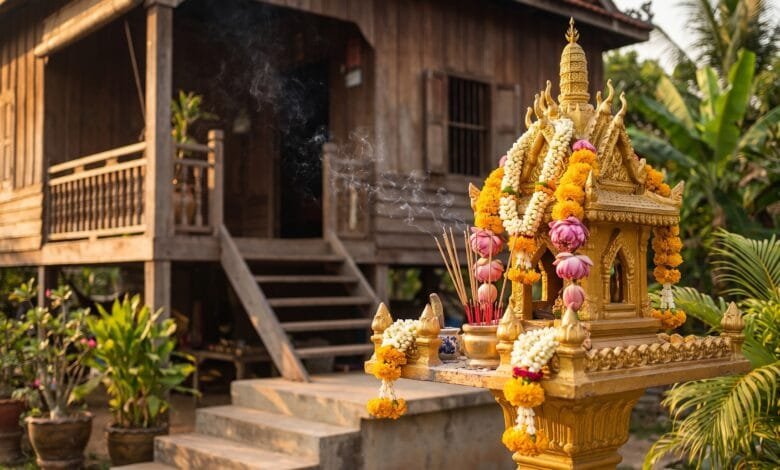
You’ll notice them within your first hour in Cambodia. Small, house-shaped shrines mounted on pillars, standing outside homes, shops, restaurants, and hotels. Some are simple wooden structures. Others are elaborate miniature temples painted in gold and bright colors, adorned with flower garlands and burning incense.
These are spirit houses. And once you start seeing them, you’ll see them everywhere.
For a foreign traveler, they raise an obvious question: what are they, and why are there so many? The answer opens a window into a belief system that has shaped Cambodian life for centuries — one that exists alongside Buddhism in a way that might surprise visitors from the West.
What Is a Spirit House?
A spirit house — known in Khmer as rean tevoda (រានទេវតា) or sometimes preah phum (ព្រះភូម) — is a small shrine built to honor and house a protective spirit associated with a particular place. The idea is straightforward: if a location has a spiritual guardian, you offer that spirit a comfortable place to reside so it will look favorably on you and your family.
The structure itself is often a miniature version of a traditional Khmer house or temple, mounted on a pillar or pedestal. The elevation keeps it above ground level, which many Cambodians understand as a sign of respect. The roof often mirrors the tiered style of Buddhist pagodas. Some spirit houses are simple bamboo structures. Others are ornate cement or bronze creations with detailed carvings.
You’ll typically find them placed near a gate, in a yard, or beside the house rather than inside it. This reflects the belief that different spaces have different spiritual occupants — the house belongs to the family, while the shrine acknowledges the spiritual character of the land itself.
Why Do Cambodians Build Spirit Houses?
The practice predates Buddhism in Cambodia. Long before Theravada Buddhism became the dominant religion, the Khmer people held animist beliefs — the understanding that spirits inhabit natural features like trees, rivers, rocks, and land. These spirits, often called neak ta (អ្នកតា), were understood as guardians of specific places. The term translates roughly to “ancient ones” or “ancestors,” and neak ta could be male or female, often operating as a couple.
When people built homes or established communities, they needed to make peace with the spirit already present on that land. The spirit house became a way to offer the guardian spirit its own dwelling, ensuring harmony between the human residents and the unseen world.
As Theravada Buddhism spread through Cambodia during the Angkor period, spirit houses absorbed Buddhist elements. Offerings of incense, flowers, water, and fruit became intertwined with Buddhist prayers and merit-making. Today, the two traditions coexist comfortably for most Cambodians. A person may visit a pagoda, make merit, and observe Buddhist customs while also maintaining a spirit shrine at home. From within this cultural framework, there is no contradiction.
What Do People Believe About Spirit Houses?
It’s important to be precise here. Different Cambodians hold different beliefs, and not everyone maintains a spirit house. But many Cambodian Buddhists understand the spirit house as a way to honor the spiritual guardian of their land and to ensure protection and good fortune for their household.
The spirit house is also connected to ancestor remembrance. Some families leave offerings for recently departed relatives, believing this brings luck in the next life for those awaiting rebirth. During Pchum Ben, the festival of the dead, offerings at spirit houses connect the living with ancestral spirits.
Some Cambodians believe that neglecting the spirit house can lead to illness, discord, or misfortune. This is not presented as a universal doctrine but rather as a widespread local understanding that has been passed down through generations.
What’s clear from speaking with Cambodians and reading the research is this: the spirit house is not superstition in the dismissive sense. It is a meaningful practice rooted in a worldview that sees the land as inhabited by spiritual forces deserving of respect.
How Are Spirit Houses Used in Daily Life?
For many Cambodian families, caring for the spirit house is part of a daily or seasonal routine. Mornings often begin with lighting incense sticks, placing fresh flowers, or setting out food offerings — rice, fruit, cakes, and sometimes even cans of soda or shots of rice wine.
Offerings vary by family tradition and local custom. Some households make offerings on Buddhist holy days (precept days). Others do so during significant life events like housewarmings or business openings, when a priest or elder may conduct a blessing ceremony to invite the guardian spirit into its new home.
During Khmer New Year, families renew offerings to invite blessings for the year ahead. The spirit house plays a role in welcoming the angels believed to carry in the New Year.
You’ll also find spirit houses at businesses, hotels, and even some pagoda grounds — anywhere people feel a particular spiritual presence or wish to ensure good fortune for their activities.
What Travelers Will Notice
As a visitor to Cambodia, you’ll see spirit houses in many contexts:
- Private homes in both cities and rural villages, often placed near the front gate or entrance
- Businesses like shops, restaurants, and guesthouses, where owners seek prosperity
- Rice fields and rural land, where farmers honor the spirit of the land
- Some pagoda grounds, where spirit houses coexist with Buddhist structures
The style of the spirit house often reflects the setting. In rural areas, they may be humble bamboo structures. In Phnom Penh or Siem Reap, you’ll see elaborate painted versions with gold accents and detailed carvings. Some wealthy homeowners commission luxurious spirit houses that mimic the style of their own villas.
You may notice that the door of the spirit house typically faces the entrance to the main building. This is intentional — the spirit is believed to bring luck and wealth to the family when properly oriented.
How to Observe Spirit Houses Respectfully
You don’t need to participate in any rituals, and no one expects you to. But a few simple gestures of respect go a long way.
- Don’t touch or disturb offerings or figurines. The items on a spirit house are placed there with intention and care.
- Stand quietly before the shrine if you wish to pay respect. A simple bow is enough.
- Avoid pointing your feet toward a spirit house when sitting nearby, as feet are considered the least respectful part of the body in Cambodian culture.
- If taking photos, be discreet. Don’t block people who are making offerings, and don’t treat the shrine as a photo prop.
These are not strict rules with harsh consequences. They are simply ways of showing that you understand something meaningful is happening — and that you respect it.
For a broader guide to respectful behavior at Cambodian religious sites, CambodiaRecipe has a dedicated Travel Tips article covering general visitor etiquette.
Spirit Houses and the Buddhist Connection
A common question from travelers is: how does this fit with Buddhism? If Cambodia is a Buddhist country, why do people worship spirits?
The answer lies in understanding how religion actually works in Cambodia. Theravada Buddhism has a central place in Cambodian religious life. But Buddhism and spirit beliefs have coexisted for centuries, each serving different needs and addressing different questions. Buddhism offers a path toward enlightenment and merit-making. Spirit houses address more immediate concerns — protection, prosperity, and harmony with the unseen world.
This coexistence is not unique to Cambodia. Across Southeast Asia, you’ll find similar patterns where local animist traditions live alongside major world religions. What makes the Cambodian expression distinctive is how seamlessly it’s woven into daily life. You don’t have to choose one or the other. You simply maintain both, and life goes on.
Frequently Asked Questions
What is a spirit house in Cambodia?
A spirit house is a small shrine built to honor a protective spirit associated with a place. It’s typically placed outside a home or business to ensure the spirit’s goodwill.
Why do Cambodians build spirit houses?
The practice comes from animist beliefs that predate Buddhism in Cambodia. Building a spirit house is a way to honor the spiritual guardian of the land and ensure protection and prosperity.
Can tourists visit or observe spirit houses?
Yes. Spirit houses are visible from public spaces. You can observe them respectfully, but you should not touch offerings or disturb the shrine.
Do all Cambodians have spirit houses?
No. Not every Cambodian maintains a spirit house, and beliefs vary among individuals and communities. But the practice is widespread and visible throughout the country.
What should I avoid doing near a spirit house?
Avoid touching the shrine or its offerings, pointing your feet toward it, or treating it as a photo prop. A quiet, respectful attitude is appreciated.
How are spirit houses connected to Buddhism?
They are connected through centuries of coexistence. Buddhist prayers and merit-making rituals are often intertwined with spirit house offerings. Many Cambodians see no contradiction between the two.
Conclusion
Spirit houses are one of the most visible expressions of Cambodian spirituality. They appear everywhere because they address something deeply human: the desire to live in harmony with the unseen forces that shape our lives.
For travelers, understanding spirit houses is a way to understand Cambodia more deeply. They reveal a worldview where Buddhism and animism coexist, where ancestors and land spirits are honored, and where the spiritual and the everyday are never far apart.
The next time you see one of these small houses standing quietly outside a Cambodian home, you’ll know what it is. And you’ll understand a little more about the people who built it.