What Is Cambodian Cuisine? A Complete Introduction to Khmer Food
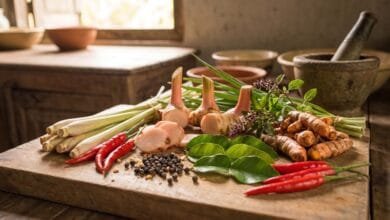
In a small kitchen in Phnom Penh, a grandmother pounds lemongrass, galangal, and turmeric into a fragrant paste—the same kroeung her mother made, and her grandmother before her. This is how Cambodian cuisine lives: not in cookbooks, but in hands, memories, and the daily ritual of feeding a family. Cambodian culinary secrets are rarely written down; recipes are handed down from mother to daughter. This is food that carries history in every bite.
Cambodian cuisine—also known as Khmer cuisine—is the national cuisine of Cambodia. At its heart is the nearly-two-thousand-year-old culinary tradition of the Khmer people. It reflects the varied culinary traditions of different ethnic groups in Cambodia, but Khmer cuisine remains its core.
After reading this article, you will understand what Cambodian cuisine is, what makes it unique, the essential ingredients that define it, how Cambodians eat, and why this ancient culinary tradition matters today.
What Is Cambodian Cuisine?
Cambodian cuisine is the food of the people of Cambodia. In Khmer, it is called សិល្បៈខាងធ្វើម្ហូបខ្មែរ (sillep kang tver mhoup Khmer), meaning “the art of Khmer cooking”.
At its simplest, Cambodian cuisine is built around three things: rice, fish, and water. The Mekong River cuts through the middle of Cambodia, and the Tonlé Sap lake—believed to have more fish than any other lake in the world—acts as the country’s liquid heart. When the rainy season begins, Cambodia turns into a vast ocean of emerald rice paddies. This geography—wetlands, floodplains, rivers, and lakes—explains why water, fish, and rice are so central to the cuisine.
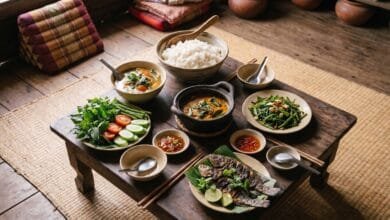
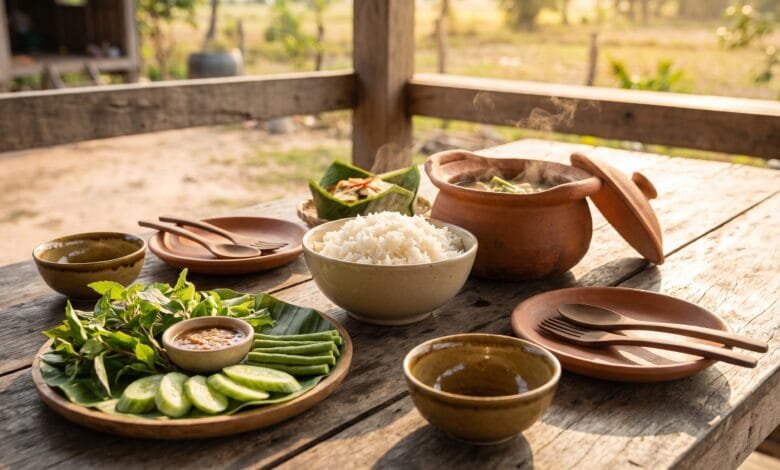
A typical Cambodian meal includes rice served with at least three other dishes: a soup (samlor), a stir-fry, a curry or salad, and dipping sauces. Each dish offers a different flavor—sweet, sour, salty, or bitter—and together they create a harmonious meal.
Why Is Cambodian Cuisine Important?
Cambodian cuisine matters not just because it tastes good, but because it tells the story of a people and a place. It is a living connection to the ancient Khmer civilization that built Angkor Wat. It reflects the influences of Indian traders who introduced spices, Chinese merchants who brought noodles and cooking techniques, and French colonizers who left behind the baguette (nom pang).
But more than anything, Cambodian cuisine is about family. Meals are shared. Food is prepared with care. The kitchen is the heart of the home. And in a country that has endured enormous hardship, the continuity of culinary tradition is a quiet act of resilience.
The Flavors Behind It
Cambodian cuisine is known for its balance of flavors. Unlike Thai food, which is often aggressively spicy, Cambodian food tends to be more subtle. Chili is usually offered on the side, allowing each person to add heat to their own taste.
The core flavors of Cambodian cuisine are:
Many dishes combine several of these flavors in a single bite—a hallmark of Khmer cooking.
Key Ingredients
To understand Cambodian cuisine, you need to know its essential ingredients.
How Cambodians Traditionally Prepare and Eat It
Cambodian cuisine is traditionally prepared with care and patience. Spice pastes like kroeung are made from scratch, using a mortar and pestle to pound fresh ingredients into a fragrant paste. Soups are simmered slowly to develop depth of flavor. Fish is fermented for months to make prahok, a process that preserves the catch and adds intense umami to dishes.
At the table, Cambodians eat with forks and spoons—rarely chopsticks. A typical meal includes:
- A bowl of rice (always)
- A soup (samlor)—often sour, sometimes sweet, usually with prahok or fish sauce
- A stir-fry or curry
- A salad or fresh vegetables
- Dipping sauces—prahok ktis (fermented fish dip with pork and coconut milk) is a favorite
Food is served all at once, family-style, and everyone shares from the same dishes. Meals are social, unhurried, and centered around togetherness.
Regional and Family Variations
One of the most important things to understand about Cambodian cuisine is that it varies—by family, by province, by season, and by what ingredients are available.
Regional specialties include:
- Phnom Penh: Known for kuy teav, a pork broth-based rice noodle soup that is Cambodia’s most popular breakfast
- Kampot and Kep: Famous for crab stir-fried with locally grown Kampot pepper
- Battambang: An agricultural heartland known for freshwater fish dishes and fermented specialties
- Siem Reap: Nom banh chok—rice noodles served with fish curry—often uses more garlic and coconut milk here
- Ratanakkiri: Indigenous communities use more red meat in their cooking, with maphea (cow innard stew) as a signature dish
- Steung Treng: Trey paseh-y dot, a grilled river fish specialty
Even within the same province, every family has their own version of a dish. There is no single “authentic” recipe—only the version that your mother or grandmother made.
The History Behind the Food
Cambodian cuisine has a history that stretches back nearly two thousand years.
Archaeological evidence shows that by the 1st and 2nd centuries, communities along the Mekong and Tonlé Sap were growing rice and gathering seafood. Indian merchants introduced spices around the 2nd century. Chinese traders arrived in the 13th century, bringing noodles and other influences.
At the height of the Khmer Empire (9th–15th centuries), palace kitchens produced a sophisticated royal cuisine. Khmer royal cooks influenced the cuisines of neighboring kingdoms, including Thailand.
In the 16th century, Portuguese and Spanish traders introduced chili and peanuts from the New World. But chili never became as dominant in Cambodia as in neighboring Thailand.
The French colonial period (19th–20th centuries) left its mark too: the baguette (nom pang) is now a beloved part of Cambodian food culture, used for sandwiches and breakfast with pâté and coffee.
Tragically, the Khmer Rouge regime in the 1970s nearly destroyed Cambodia’s culinary heritage. Many recipes were lost, and food became a matter of survival rather than pleasure. But since the 1990s, Cambodian cuisine has been undergoing a quiet revival—led by families, restaurants, and a new generation proud of their culinary heritage.
When Cambodians Eat It
Cambodian cuisine is woven into the rhythm of daily life and the cycle of festivals.
Breakfast often includes noodle soups like kuy teav or nom banh chok. Lunch and dinner are built around rice with multiple side dishes.
Festival foods play an important role:
- Khmer New Year: Families prepare special dishes, including traditional desserts and rice-based treats
- Pchum Ben (Ancestors’ Day): Food offerings are made to ancestors at pagodas
- Water Festival (Bon Om Touk): Communities celebrate with feasts featuring freshwater fish from the Tonlé Sap
- Weddings: Elaborate multi-course meals are served, often including royal-inspired dishes
How to Experience It in Cambodia
The best way to experience Cambodian cuisine is to eat like a Cambodian:
- Visit a local market in the morning—watch vendors prepare noodles, soups, and snacks from scratch
- Eat street food—nom banh chok from a vendor with buckets hanging from a pole, grilled meats, and fresh fruit
- Order a traditional meal at a local restaurant—rice, samlor (soup), and a stir-fry or curry
- Join a family meal if you have the opportunity—this is where you’ll taste the real thing
In Phnom Penh, try kuy teav for breakfast. In Kampot, order the crab with Kampot pepper. In Siem Reap, don’t miss nom banh chok. Every province has its own specialty worth discovering.
How to Experience It at Home
You don’t need to travel to Cambodia to enjoy Cambodian cuisine. Many ingredients are now available at Asian grocery stores or online:
- Prahok (fermented fish paste) is the most distinctive ingredient—use it sparingly in soups and dipping sauces
- Kroeung can be made at home by pounding lemongrass, galangal, garlic, shallots, turmeric, and kaffir lime leaves
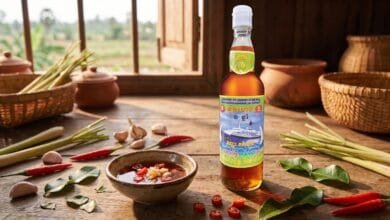
- Fish sauce, palm sugar, and coconut milk are widely available
- Jasmine rice is a good substitute for Cambodian rice varieties
Start with simple dishes like chicken curry (kari sach moan) or a sour soup (samlor machu). For a full recipe, check out our Cambodian recipe collection on CambodiaRecipe.com.
What Makes This Food Cambodian?
What makes Cambodian cuisine distinctly Cambodian?
- The ingredients: Prahok, kroeung, and the abundant use of freshwater fish from the Mekong and Tonlé Sap
- The flavors: A balance of sweet, sour, salty, and bitter, with chili offered on the side rather than dominating
- The techniques: Mortar-and-pestle pastes, slow-simmered soups, and fermentation
- The culture: Family-style dining, rice with every meal, and food as a expression of love and tradition
- The history: Two thousand years of Khmer culinary tradition, shaped by Indian, Chinese, and French influences but always distinctly Cambodian
Frequently Asked Questions
What is Cambodian cuisine?
What food is Cambodia famous for?
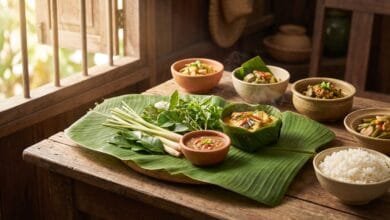
Cambodia is famous for fish amok (a steamed fish curry in banana leaves), nom banh chok (rice noodles with fish curry), kuy teav (rice noodle soup), lok lak (stir-fried beef), and prahok ktis (fermented fish dip)
What do Cambodians eat every day?
What makes Khmer food different from Thai food?
What are the main ingredients in Cambodian cooking?
The main ingredients are rice, prahok (fermented fish paste), kroeung (spice paste), fish sauce, palm sugar, coconut milk, lemongrass, galangal, and kaffir lime leaves.
Is Cambodian food spicy?
What should I try first?
If you’re new to Cambodian food, start with fish amok (the national dish), nom banh chok (rice noodles with fish curry), or kuy teav (noodle soup for breakfast). These dishes are approachable and delicious.
What is traditional Khmer food?
Traditional Khmer food includes dishes like fish amok, samlor (soups), kroeung-based curries, grilled fish, and rice with numerous side dishes—all prepared using traditional techniques and local ingredients.
Conclusion
Cambodian cuisine is one of Southeast Asia’s oldest and most underappreciated culinary traditions. It is a cuisine shaped by water, rice, and fish—by the rhythms of the Mekong and Tonlé Sap, by the hands of mothers and grandmothers, and by two thousand years of history.
It is not flashy or aggressively spicy. It is subtle, balanced, and deeply satisfying. It is food that tastes like home—even if you’ve never been to Cambodia.
Whether you’re planning a trip, exploring a new cuisine in your kitchen, or simply curious about the world, Cambodian cuisine has something to offer. Start with the basics. Try a dish. Visit a market. Sit down to a family-style meal. And taste the story of Cambodia.
Want to try cooking Cambodian food at home? Explore our Cambodian recipes for step-by-step instructions on classic dishes.