Essential Cambodian Herbs: Lemongrass, Galangal, Kaffir Lime and More
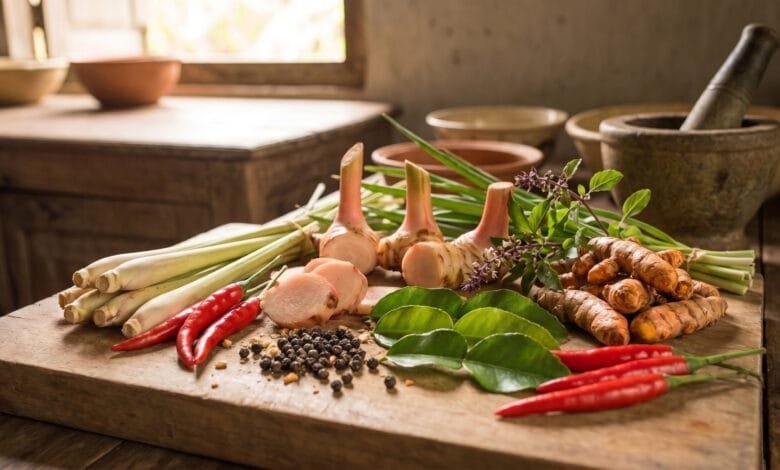
Step into a Cambodian kitchen and the first thing that hits you is the aroma — lemongrass bright and citrusy, galangal earthy and warm, kaffir lime sharp and fresh. These are the smells of Khmer cooking. These are the smells of home.
Cambodian cuisine is built on a foundation of fresh aromatic herbs. Unlike many Western kitchens where dried spices sit in jars for months, Cambodian cooking demands fresh herbs — pounded, crushed, and released into dishes at just the right moment. Cambodian herbs are not mere garnishes; they are the soul of Khmer food.
This article explores the essential Cambodian herbs that define Khmer cuisine — what they are, how they taste, how Cambodians use them, and why they matter. Whether you are discovering Cambodian food for the first time or looking to cook Khmer dishes at home, understanding these herbs is your first step.
What Are the Essential Cambodian Herbs?
The most important Cambodian herbs in Khmer cooking include lemongrass, galangal, kaffir lime, turmeric, garlic, and shallots. These six ingredients form the base of kroeung — Cambodia’s signature aromatic paste — and appear in countless soups, curries, stir-fries, and marinades.
| Herb | Khmer Name | Role in Cambodian Cuisine |
|---|---|---|
| Lemongrass | ស្លឹកគ្រឺ (sleuk krey) | Provides bright citrus aroma; base of most kroeung pastes |
| Galangal | រំដេង (romdéng) | Adds earthy, pine-like warmth; essential in soups and curries |
| Kaffir Lime | ក្រូចសើច (kroch saech) | Leaves and zest give sharp citrus notes; used whole or pounded |
| Turmeric | ល្មៀត (lmiet) | Golden color and earthy flavor; distinguishes Khmer curry pastes |
| Garlic | ខ្ទឹមស (khtœ̆m sâ) | Universal aromatic; adds depth to every paste and dish |
| Shallots | ខ្ទឹមបារាំង (khtœ̆m barang) | Sweet onion flavor; used alongside garlic in almost everything |
These Cambodian herbs work together in harmony. No single herb dominates; each contributes a layer of flavor that, when combined, creates the distinctive taste of Khmer food.
Lemongrass — The Bright Heart of Khmer Cooking
Lemongrass is perhaps the most recognizable of all Cambodian herbs. With its long, slender stalks and fresh lemon-like aroma, it appears in nearly every Khmer dish that requires depth and brightness.
In Cambodia, lemongrass grows abundantly. You will see it in gardens, markets, and along roadsides. Cambodians use the tender lower part of the stalk — the white portion — slicing it thinly or pounding it into paste. The tough upper leaves are sometimes tied in knots and added to soups for flavor, then removed before serving.
What does lemongrass taste like? It is bright, citrusy, and slightly floral — like lemon but milder, with a hint of ginger. Unlike lemon juice, lemongrass adds aroma without acidity.
In Khmer cooking, lemongrass is used in:
- Kroeung — the essential Cambodian spice paste
- Soups — floated in samlor (soups) for gentle infusion
- Curries — pounded into curry pastes
- Marinades — mixed with other herbs for grilled meats
- Stir-fries — sliced thin and cooked with meat and vegetables
Lemongrass is also used in traditional Cambodian medicine, believed to aid digestion and relieve cold symptoms.
Galangal — The Earthy Rhizome
Galangal is one of the less familiar Cambodian herbs to international cooks, yet it is absolutely essential in Khmer cuisine. Related to ginger but with a distinctly different flavor, galangal has a firm, woody texture and a pale, pinkish flesh.
In Khmer, galangal is called romdéng (រំដេង). It is a common ingredient across Southeast Asian cuisines but holds a special place in Cambodian cooking.
What does galangal taste like? It is earthy, pine-like, and slightly spicy — like ginger but more floral and less sharp. Some describe it as having a soapy, medicinal quality that becomes warm and inviting when cooked.
Galangal is used in Cambodian cuisine in several ways:
- In kroeung — pounded with lemongrass and other herbs
- In soups — sliced and simmered to release its earthy aroma
- In curries — providing depth and warmth
- In marinades — especially for grilled meats
Traditional Cambodian medicine uses galangal to treat indigestion, flatulence, and respiratory issues. It has been used for centuries as a digestive aid.
Kaffir Lime — The Citrus Punch
Kaffir lime — known in Khmer as kroch saech (ក្រូចសើច) — is one of the most distinctive Cambodian herbs. The tree produces two valuable ingredients: the uniquely shaped double leaves and the bumpy, green fruit.
The leaves are the star. They have a glossy, leathery texture and are shaped like two leaves joined end to end. When torn or sliced, they release an intense citrus aroma that is sharper and more floral than regular lime.
The fruit itself has a thick, wrinkled rind. In Cambodian cooking, the leaves and the rind are used — but not the juice. The zest of the kaffir lime is pounded into kroeung, while the leaves are added whole to soups or sliced into thin ribbons for curries and stir-fries.
Kaffir lime leaves are used in:
- Kroeung — pounded with lemongrass and galangal
- Soups — floated whole or torn
- Curries — especially fish amok and other coconut-based dishes
- Stir-fries — sliced into thin ribbons
In traditional Cambodian medicine, kaffir lime leaves are used to treat nausea and improve circulation. The fruit is sometimes candied and eaten as a treat.
Turmeric — The Golden Spice
Turmeric, called lmiet (ល្មៀត) in Khmer, is both a spice and a herb. The fresh root — knobby and orange-gold — is preferred in Cambodian cooking over the dried powder commonly found in Western supermarkets.
What does turmeric taste like? It is earthy, slightly bitter, and warm. It adds more than flavor; it gives Cambodian curries and kroeung their characteristic golden color.
Turmeric’s use in Cambodia is ancient, dating back to early Indian traders who brought it to the region. Today, it appears in signature Khmer dishes like Fish Amok, Nom Banh Chok, and in kroeung itself.
How Cambodian Herbs Come Together: Kroeung
The magic of Cambodian herbs is most visible in kroeung (គ្រឿង) — the aromatic paste that forms the foundation of Khmer cooking.
Kroeung is made by pounding together lemongrass, galangal, kaffir lime leaves (and sometimes zest), turmeric, garlic, and shallots in a mortar and pestle. Traditionally, this is done by hand. The cook pounds the toughest ingredients first — lemongrass and galangal — then adds the others in sequence. The result is a fragrant, slightly coarse paste that releases the full oils and aromas of each herb.
There are different colors of kroeung:
- Yellow kroeung — made with more turmeric, used in curries and marinades
- Green kroeung — lemongrass dominates
- Red kroeung — includes dried red chilies
Kroeung is Cambodia’s answer to curry paste — but it is distinct. Unlike Thai curry pastes, kroeung is often made without chilies, and turmeric is almost always present. The result is aromatic and warm rather than fiery hot.
Regional and Family Variations
Just as recipes vary from family to family, the use of Cambodian herbs varies across the country.
In coastal provinces like Kampot and Kep, dishes often feature more kaffir lime. In the Tonle Sap region, freshwater fish dishes rely heavily on lemongrass and galangal to balance the richness of fish. In Phnom Penh, urban cooks may use a wider variety of herbs reflecting the capital’s diverse influences.
Every family has its own way of making kroeung. Some add more lemongrass, others more galangal. Some include dried chilies, others do not. These variations are not “wrong” — they are part of the living tradition of Cambodian cooking.
The History Behind Cambodian Herbs
The Cambodian herbs used today tell a story of cultural exchange. Turmeric arrived with Indian traders centuries ago, bringing the golden color and earthy flavor that now define Khmer curries. Lemongrass and galangal were adopted from regional traditions and became central to Khmer cooking.
Cambodia’s position at the crossroads of Southeast Asia meant that flavors traveled in from India, China, and neighboring kingdoms. But Cambodian cooks made these herbs their own — combining them in unique ways that reflect Khmer tastes and ingredients.
When Cambodians Use These Herbs
Cambodian herbs are not reserved for special occasions. They are used every day.
- Breakfast: Nom Banh Chok, Cambodia’s rice noodle dish, is flavored with lemongrass and kaffir lime in its curry-like sauce.
- Lunch and dinner: Soups, stir-fries, and curries all feature these herbs.
- Festivals: During Khmer New Year and Pchum Ben, families prepare elaborate dishes that showcase the full range of Cambodian herbs.
- Weddings: Traditional wedding feasts include dishes flavored with kroeung.
How to Experience Cambodian Herbs in Cambodia
If you visit Cambodia, the best way to experience these herbs is at the market. Phnom Penh’s markets — like Central Market or Orussey Market — are overflowing with fresh lemongrass, galangal, and bundles of kaffir lime leaves. The smell alone is unforgettable.
Street food stalls use these herbs in everything from grilled skewers to noodle soups. In Siem Reap, Kampot, and Battambang, local restaurants serve dishes that let the herbs shine.
How to Cook with Cambodian Herbs at Home
You do not need to be in Cambodia to cook with Cambodian herbs. Many are available at Asian grocery stores or online.
Substitutions:
- Lemongrass: Use lemon zest with a pinch of ginger — but fresh lemongrass is irreplaceable for true flavor.
- Galangal: Ginger is the closest substitute, though the flavor will be different.
- Kaffir lime leaves: Lime zest can work in a pinch, though it lacks the leaf’s complexity.
Storage tips:
- Lemongrass: Wrap in a damp paper towel and refrigerate for up to two weeks, or freeze.
- Galangal: Wrap and refrigerate for up to three weeks, or freeze sliced.
- Kaffir lime leaves: Freeze in a zip-lock bag — they keep for months.
What Makes These Herbs Cambodian?
It is not just the herbs themselves — it is how they are used. In Cambodian cooking, these herbs are not background flavors. They are the main event. Pounded together in a mortar, they become the base of nearly every dish. No Cambodian kitchen is complete without them.
Frequently Asked Questions
What are the most common Cambodian herbs used in cooking?
The most common Cambodian herbs are lemongrass, galangal, kaffir lime, turmeric, garlic, and shallots. These form the base of kroeung, Cambodia’s essential spice paste.
What is the difference between Cambodian herbs and Thai herbs?
Can I use dried herbs instead of fresh Cambodian herbs?
Fresh herbs are strongly preferred in Cambodian cooking. The flavors are brighter and more aromatic. Dried substitutes will not produce the same result.
What is kroeung in Cambodian cooking?
Where can I buy Cambodian herbs?
Asian grocery stores often carry fresh lemongrass, galangal, and kaffir lime leaves. Specialty online retailers also sell these herbs.
Conclusion
Cambodian herbs — lemongrass, galangal, kaffir lime, and their companions — are more than ingredients. They are the foundation of Khmer cuisine, the smells that define Cambodian cooking, and the flavors that connect generations. Whether you are exploring Cambodian food for the first time or cooking Khmer dishes in your own kitchen, these herbs are your starting point. They are the taste of Cambodia.